
Ellen O’Malley Camps (Helen Camps) launched the Trinidad Tent Theatre project in 1982. It began with a group of twenty-five trainee performers-technicians, and a rented, leaky, very patched tent. The project reached a natural conclusion in 1987 with the disintegration of a second tent and Camp’s recognition of the fact that the trainees had become expert in different theatrical fields. Former members are now the professional actors, directors, and producers of Trinidad and Tobago – a few with their own theatre companies and theatre spaces.
Trinidad Tent Theatre was first and foremost experimental. It attempted to create a style and theatrical form suited to the resources and the realities of the Caribbean.
Trinidad Tent Theatre was committed to the development of a theatre professional capable of sustaining her/himself financially through his/her craft. To this end the performing company was rigorously trained in a variety of theatre disciplines and each member appeared in at least two full-scale productions as part of this training. The training was free of charge and no money was earned during the apprenticeship period.
Training covered voice, movement, text and sub-text work, theatre techniques (based on the traditional movements, chants, rituals and characterisations of Carnival), promotion and publicity, lighting, sound, stage management, community relations and personal development.
Tutors included those belonging to the Trinidad Tent Theatre as well as various Caribbean specialists invited from time to time for specific workshops.
The goal of this all-round foundation training was obviously aimed at producing professionals grounded in all aspects of theatre – total theatre practitioners. Those opting for a particular discipline could subsequently become members of the Trinidad Tent Theatre Company, or part of the technical and administrative sectors of the theatre assisting in the training of new pupils. Some used the training to freelance, benefiting the country as a whole while earning a salary.
Trinidad Tent Theatre Objectives
TO develop a Carnival Theatre training (based on the development of qualities such as will, power, inclusion, beauty, harmony, organization creativity and interdependence) and a Theatre of Carnival (to preserve the traditional Carnival characters and rituals mostly lost from the commercial extravaganzas of the modern carnival).
TO increase the accessibility of theatre to the Trinidad and Tobago audience. In addition to working with the Ministry of Community Development in reaching out to urban communities in the country, the company gave a free show every Sunday evening during a regular season. The shows such as Mas In Yuh Mas, J’ouvert, Go To Hell, New Waves (1, 2 And 3), Cinderama, Sno-Kone And The Seven Dwens, Variations And Rampanalgas Sunrise were aimed at children and young adults and introduced them to the possibilities and excitement of theatre and of aspects of their culture.
TO use theatre techniques and Carnival traditions in schools and institutions to help build a sense of cultural identity.
TO enrich the cultural lives of people in the wider community by sharing the living experience of theatre with them.
TO help Government in an experiment attempting to iron out some of the problems caused by the then “shift school system”. Trinidad Tent Theatre members worked two hours daily in a Junior Comprehensive school.
TO continue to develop and extend the Theatre School functions of the Trinidad Tent Theatre. Formal classes alternated with practical sessions creating and producing indigenous Carnival and Pop musicals along with more formal theatrical pieces written by established authors. Thus, while the training objective was served, the Trinidad Tent Theatre, produced theatre that related strongly to the Caribbean and to those issues that affected its people.
TO extend the emotional range of the performer. Plays such as Equus, Bent, Statements After An Arrest According To The Immorality Act, Freedom Of The City, The Maids, Lovers, Actor’s Nightmare And Sr. Ignatius Tells It All, were studied and performed.
TO train young people in all aspects of theatre and so facilitate the development of professionals capable of sustaining themselves financially.
The Trinidad and Tobago Tent Theatre ethos continues – in varying degrees – as part of the professional work of former trainees (See Teyat Toutafe St. Lucia, Brown Cotton Tent Theatre Ensemble: Outreach and Street Theatre (Trinidad)
Trinidad Tent Theatre Original Home: The Original Tent
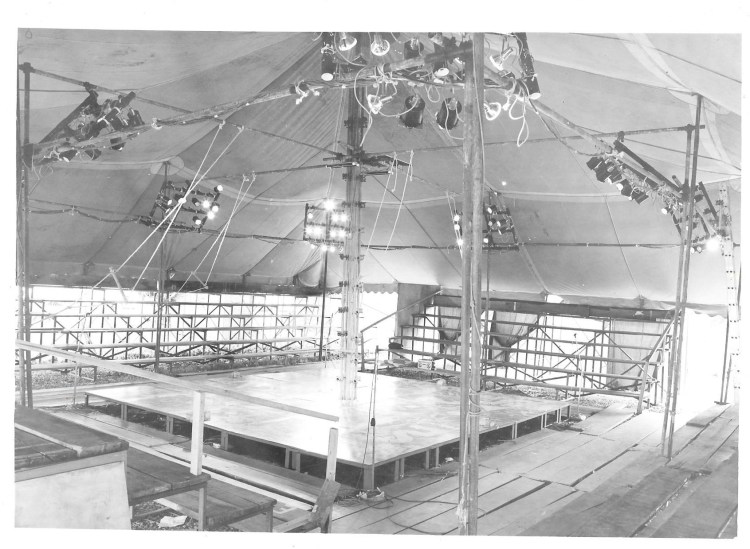
The original Tent was adapted as follows by my Technical Director Mr. Francis Lewis. The Tent was sixty (60) feet X sixty (60) feet square. The Tent was supported with a one (single) Center Pole that rose about twenty-five (25) feet (or more) off the ground. Eight (8) foot high poles supported the sides of the Tent. There were about eight (8) or ten (10) side-support poles, space-out every eight (8) feet or so along the side of the Tent.
The Tent did not have drop curtains along the sides. We used lengths of cheap, black cotton to create drop curtains along the sides. .
Our stage was twenty (20) feet X twenty (20) feet square. The stage was one (1) foot high, off the ground, constructed around the Tent’s Center Pole. It was built in sections so as to be modular (we could un-bolt the sections when we needed to move). Each stage module was made of one and one-half inch angle iron. We used a triple-material stage floor. The lowest level (the “foundation”) was three-quarter dense and heavy marine plywood, covered with half-inch Celotex. This was covered with Hardboard (Masonite), with the smooth side up giving us an exceptional stage floor, which the dancers particularly liked. The stage floor was very sturdy and could take more than 25 people jumping and dancing simultaneously while having the right amount of “Bounce” or “Give”.
Also, we built a three (3) foot X four (4) foot platform, around the Center Pole, about fifteen (15) feet high of the stage floor.
For our seating we used the old, traditional bleacher-type seating that the Government had used for many years for Carnival (we “pilfered” these from the National Carnival Commission). These bleachers had seven (7) seating levels. Each treader was two (2) feet wide. Each riser was one (1) foot high.
In other words, imagine a stair – the flat part of the stair where you put your foot (i.e. the treader) was two (2) feet wide and the vertical part of the stair over which you have to lift your foot (i.e. the riser) was one (1) foot high.
Thus, if you looked at a bleacher from the side (it would look like a big, right angle triangle, with steps instead of a slope), the horizontal dimension of the bleacher (along the ground) was fourteen (14) feet and the vertical dimension of the bleacher (rising up into the air) was seven (7) feet.
Typically, we could only use the first five (5) seating levels. We did not use the top two (2) seating levels. A theatre-goer could not sit comfortably at these top levels, because heads would bounce the sloping roof of the tent.
We constructed a small booth out of plywood for ticket sales. This served as our “Front Office”.
Our “Back Stage” and storage area was a twenty (20) foot container. In this Francis built costume storage hanging rails and a make-up/dressing-room table complete with mirrors and make-up lights. When the Container was not in use as a Dressing Room, we used it for very secure storage.
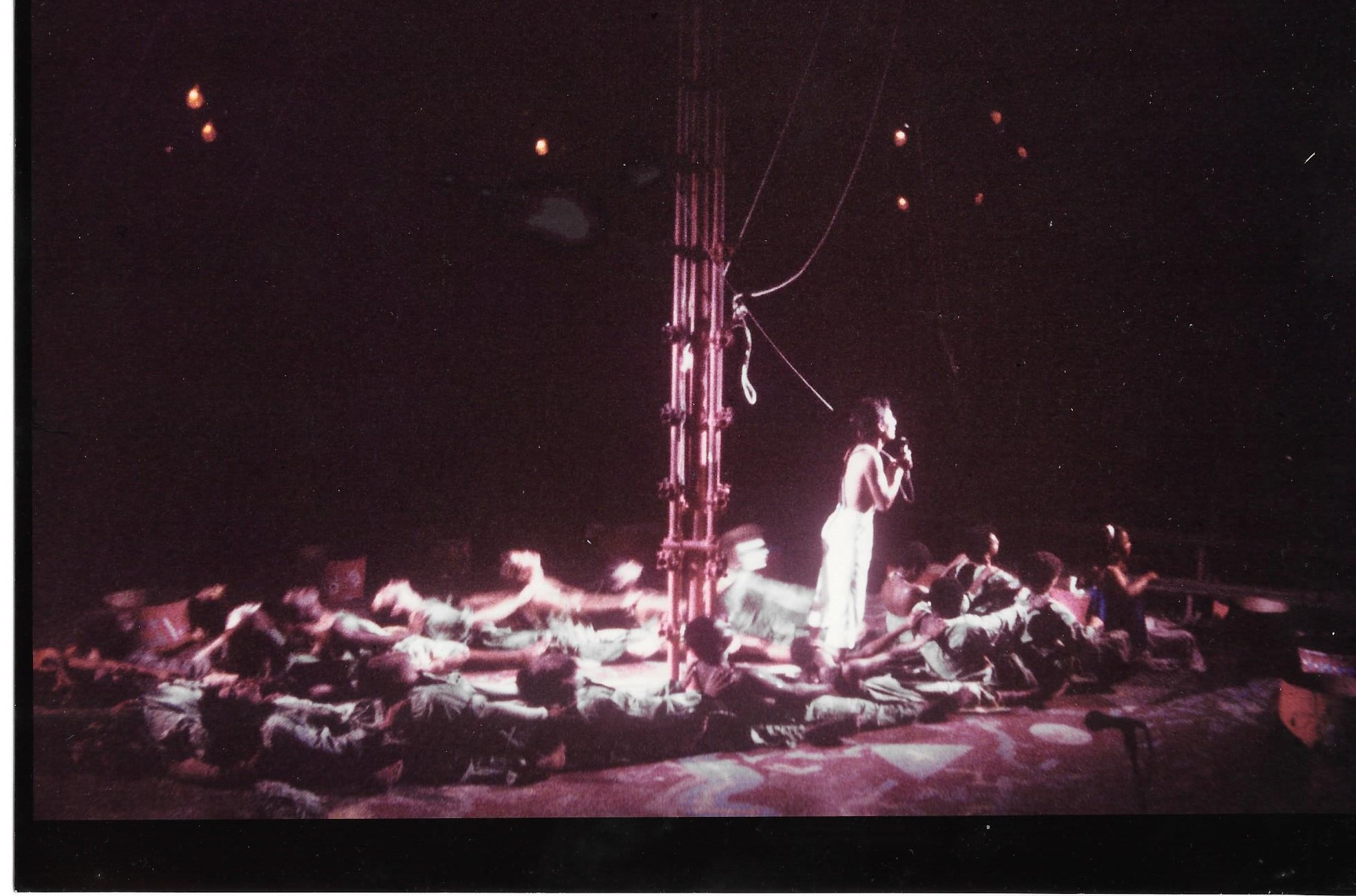
 Ellen O'Malley Camps