The main objective of the experimental Trinidad Tent Theatre was the development of a theatre form and style rooted in the traditions surrounding the country’s annual Carnival.
The Trinidad Tent Theatre identified with the spirit of the Carnival festival, which allows for the creation of works of art for its duration and their destruction at its end. The Trinidad Tent Theatre along with many other Carnival artists recognized the ephemeral nature of their art and accepted that the best way for the images to live eternally was in the minds of the people.
The Trinidad Tent Theatre also recognized calypsonians and traditional ole’ mas players as the original Carnival Theatre actors and narrators. Trinidad Tent Theatre honoured the fact that they have kept alive the spirit of political satire, which is exemplar of a society espousing freedom of speech.
The Trinidad Tent Theatre recognized that over the years Trinidad’s Carnival celebration out grew its roots with the massive participation of larger and larger sections of the population. The direction simply changed and with it the loss or gradual disappearance from the streets of the Traditional Carnival Characters
Deploring this loss Trinidad Tent Theatre’s artistic director (Camps) came up with the idea for a theatrical Carnival production which would debate the pros and cons of Trinidad and Tobago’s annual Carnival. It was to be a Theatre of Carnival production called Mas In Yuh Mas. Writer Felix Edinborough and dialect poet Paul Keens Douglas worked on the script. Wayne Berkley (Carnival band leader/designer) designed the costumes. Molly Ahye (folklorist/choreographer) ensured that the movements and dances were traditionally correct. Roger Israel (composer/lyrist/arranger) arranged the old time calypsos used in the show. The production married the unique rhythms of speech and movement of the Midnight Robber, Pierrot Grenade, Jab Jabs, Jab Molasses, Burroquite, Jamette, Baby Doll, Minstrels, Moko Jumbie, Firemen, Sailors, Bat, Dragon and Dame Lorraine with the refrains of old time calypsos and the dying art of calypso extempo (on the spot composing).
The following year a new Theatre of Carnival production called King Jab took the ground covered in the Mas in Yuh Mas show and advanced it further through the realization of the elements of political satire underlying the spirit of Carnival.
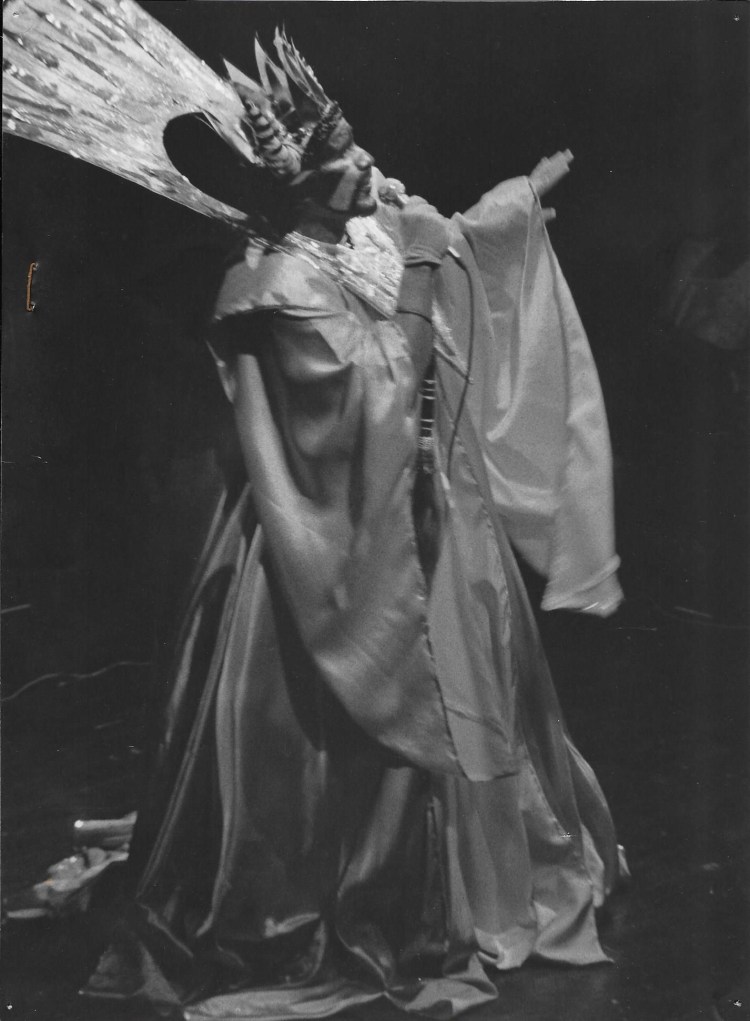
An invitation to the 1982 Traditional Folk Festival in Europe demanded a production that was thematically universal and so the ever-present threat of nuclear war was chosen as the theme for this show. Ms. Camps chose J’ouvert as the title as this word implied for her the hope implicit in all new beginnings. The patois word J’ouvert (New Dawn – Beginning) traditionally describes the “dawn signal” with a fired cannon shot for the Carnival celebrations on the Monday and Tuesday preceding Lent in Trinidad and Tobago.
In this Theatre of Carnival production (J’ouvert), the power struggles, fights, competition, threats, deceits, evasions of the great world powers paralleled the same elements inherent in traditional Carnival – warring mas camps, steelband clashes, calypsonians competing for a monarch crown. J’ouvert used the politically satirical form of the traditional Carnival characters of Trinidad and Tobago to theatricalize the threat of nuclear war. Visually, Carnival can be divided into “old mas” and “pretty mas”. In its costuming, J’ouvert focused on the “pretty mas” aspect of Carnival.
The following year, Trinidad Tent Theatre produced Go To Hell, which, in its costuming and style, focused on the “old mas” aspect of Carnival (echoing the costuming and style of the early and late eighteen hundreds Jamette bands).
In 1985, Trinidad Tent Theatre involved itself in Carnival street theatre when it worked alongside Carnival bandleader Peter Minshall co-writing, producing, directing and performing APOCALYPSO the music/calypso which lead Minshall’s Carnival portrayal – Princes Of Darkness Lords Of Light – The Golden Calabash – onto the big stage in the Port of Spain Savannah
Trinidad Tent Theatre took Theatre to the people. Recognizing that the majority of the country’s youth had neither seen nor heard their traditional Carnival folk characters the Tent Theatre company performed in the streets, in shopping malls, in schools and community centres using the traditional Carnival method of begging (rather than charging a set fee) for remuneration.
Trinidad Tent Theatre culminated its 1986 touring year with performances for Caribbean Focus hosted by the Commonwealth Institute in London. Trinidad Tent Theatre considered it imperative that its Carnival Theatre rehearsal process and its Theatre of Carnival product be part of the Caribbean Focus not only in order to establish a concept of Carnival Theatre (process) and Theatre of Carnival (product) among other Caribbean countries but also internationally. Towards this end the Trinidad Tent Theatre company presented a “Mini Carnival” package for its Caribbean Focus Tour: J’ouvert – Its Theatre of Carnival musical and Come Leh We Go – A Carnival Theatre workshop devised to introduce participants to the history, traditions, rhythms, costumes, language and dances of the Trinidad and Tobago Carnival.
 Ellen O'Malley Camps